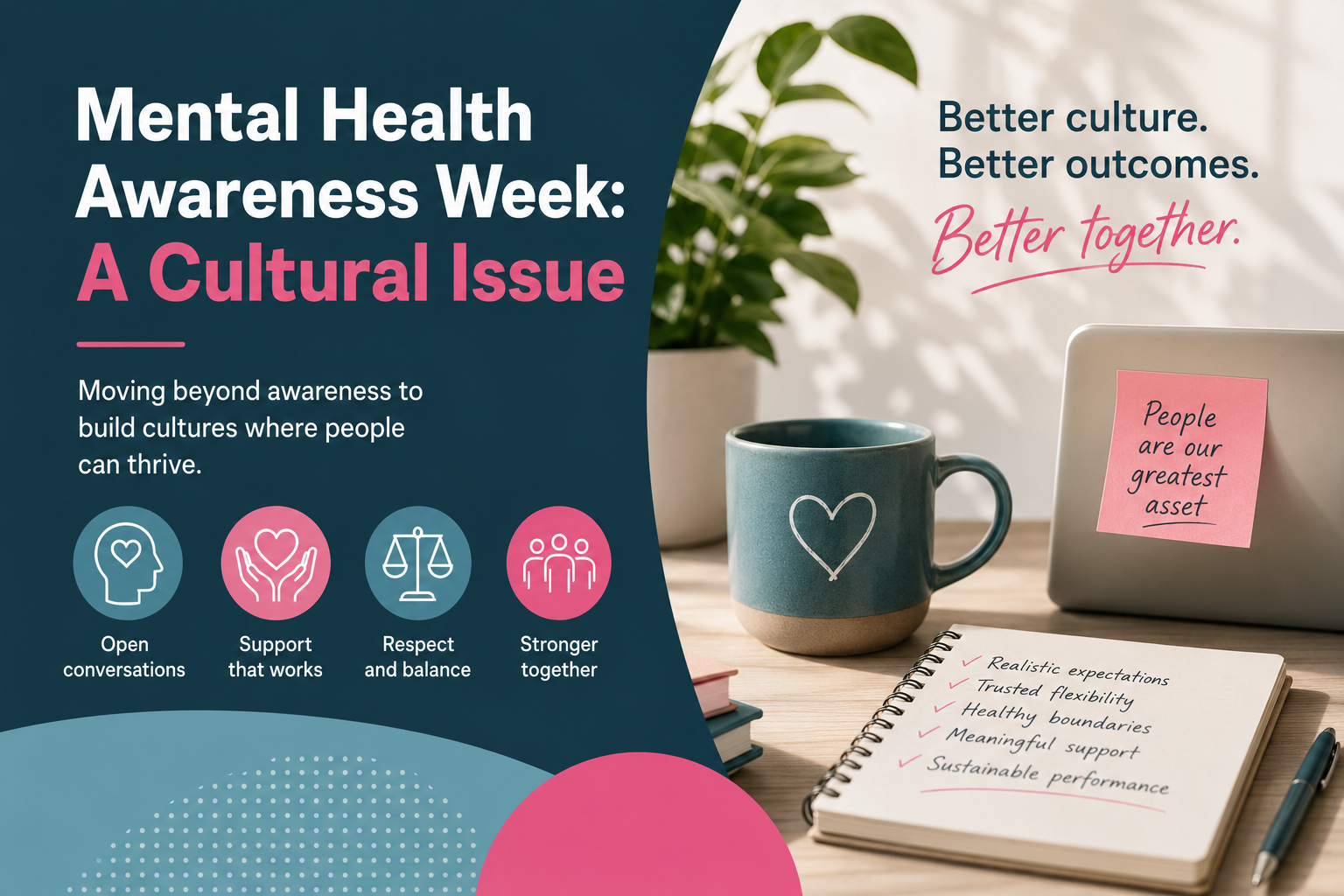
Mental Health Awareness Week: A Cultural Issue
During Mental Health Awareness Week, there will be plenty of well-intentioned posts about wellbeing, resilience and support. Most firms now recognise that mental health matters, and that is genuine progress. However, from a recruitment perspective, there is still a significant gap between what many firms say about culture and what professionals actually experience day to day.
Legal & other professional services firms have become far better at talking about mental health. But talking about it and genuinely addressing it are not the same thing.
During Mental Health Awareness Week, there will be plenty of well-intentioned posts about wellbeing, resilience and support. Most firms now recognise that mental health matters, and that is genuine progress. However, from a recruitment perspective, there is still a significant gap between what many firms say about culture and what professionals actually experience day to day.
In marketing and business development teams across legal and broader professional services, pressure has intensified considerably over the last few years. Teams are leaner. Expectations are higher. The pace is relentless. People are expected to be commercially strategic, operationally excellent, responsive, creative, data-driven and constantly available, often all at once.
At the same time, many firms are still operating within cultures that quietly reward presenteeism, overwork and permanent urgency.
The result? Increasingly capable professionals are burning out, disengaging or simply deciding the environment is no longer sustainable.
What is interesting is how much candidate priorities have changed. Five years ago, conversations were dominated by salary, progression and title. Those things still matter, of course. But today, experienced marketing and BD professionals are asking very different questions:
• What is leadership really like?
• Are expectations realistic?
• Does the firm respect boundaries?
• Is flexibility trusted or merely tolerated?
• Can you build a successful career here without sacrificing your personal wellbeing?
These are no longer secondary considerations. For many candidates, they are decisive factors and firms that dismiss this as a “generational mindset shift” risk misunderstanding what is actually happening. This is not about people wanting less accountability or lower standards. In fact, the strongest candidates are often the most ambitious. They simply no longer see burnout as a badge of honour. The firms attracting and retaining the best talent are usually not the ones offering the biggest salaries. They are the firms where leadership is emotionally intelligent, workloads are better managed, communication is healthier and high performance is sustainable.
That is becoming a genuine competitive advantage.
There is also an uncomfortable truth legal & professional services firms still struggle to acknowledge, that cultural problems are often leadership problems.
You cannot encourage wellbeing while rewarding behaviours that undermine it. You cannot talk about balance while celebrating exhaustion. And you cannot expect people to speak openly about mental health if the culture penalises vulnerability.
Candidates see through performative wellbeing very quickly. What they are looking for is consistency between messaging and reality.
Mental Health Awareness Week should not simply be another awareness campaign. It should be a prompt for firms to ask difficult questions about how their people actually experience the workplace. Culture is no longer an internal HR issue. It is directly impacting hiring, retention, performance and reputation across the professional services sector. The firms that truly understand that are the ones building stronger, more resilient teams for the future.